Angel Millar on Chaos Magic, Freemasonry & Destiny
In this interview, I speak with Angel Millar about his journey through Chaos Magic, Freemasonry, initiation, masculinity, creativity, and the occult. We explore the ideas that shaped his work, his philosophy of self-mastery, and what it means to cultivate a multidimensional life in an age of chaos.

You started learning about the occult when you were still very young. What first led you
towards magic, mysticism, and esotericism?
Looking at my upbringing, I don’t think it was something that you’d predict. I grew up in England, which was very secular, and my family had no real interest in religion. I had gone to church several times with the Cub Scouts (not with my family), and I read a few books on UFOs
by a researcher and skeptic of the phenomenon, and I collected newspaper clippings on the subject. I was obviously curious about existence. Around the age of 15, when I saw a book on astral projection and the elements at a local bookstore, I bought it and tried one of the exercises.
About a year later, I bought A Book of Pagan Rituals by Herman Slater, a New York-based author and proprietor of the Magickal Childe bookshop there (though I didn’t know that at the time).
Later, at 17, some friends took me to a shop that sold Hippie clothing, New Age-type ornaments, and books on the occult and neopaganism. I started hanging out there, spending most of my free time there, sometimes day and night, talking with the owner. He was a neopagan “elder.”
He had run a pagan circle before, but it had come to an acrimonious ending. If I had been more aware, or less enthusiastic, I might have noticed that those who hung around the shop had done so for less than a year.
After a few months or so, the shop owner formed another circle. We did some “pathworkings” and some generic neopagan rituals out in the woods, and, once, on a wasteland. He was a conflicted character. He imparted the idea that there was something mysterious about the world,
about nature, and even about the human condition. But if you asked too many questions that he couldn’t easily answer, progressed too far in magic, or expressed interests outside of generic neopaganism, you started to fall under suspicion. By 18, I was reading Crowley, Mircea Eliade,
and other books that I considered more serious. But I was eager for more.
How did you become interested in Chaos Magic, and what did your involvement with the Illuminates of Thanateros teach you at that stage of your life?
I had started going to the British Museum, and I’d come across Atlantis (officially The Atlantis Bookshop), a couple of blocks away on Museum Street. I was buying books and esoteric magazines there. I picked up a newsletter one day. It was printed on orange paper. Inside was an
article about The Illuminates of Thanateros (AKA The Magical Pact of the Illuminates of Thanateros). Chaos Magic was virtually unheard of at the time. I hadn’t read Liber Null & Psychonaut, but I was impressed by what I read. The IOT sounded serious.
I sent a letter expressing interest in joining, and received a reply two days later. The Londontemple of the IOT was holding a get-together in a pub in Pimlico, near Victoria train station.
There, I met three of the members—Ian, Ingrid, and Nick.
Not long after, I was invited to an open meeting of the London Temple. I really wanted to be initiated, so I wrote to Charles Brewster—the temple’s Insubordinate, and a person reminiscent of Crowley—and asked if I could perform a ritual of my own devising. I remember my heart
beating faster as it became time for me to perform it. I was 19 at this point, eight years younger than Nick, the youngest member of the temple at that time.
I was invited to join the Order and asked to work through Liber MMM. Two or three months later, I was initiated by Peter Carroll, author of Liber Null & Psychonaut. (He happened to be travelling from Bristol with a small IOT entourage that weekend.)
That was in 1990. Being a member of the London temple—Temple Misanthropy—at that time was an intense experience. It was an intense time—”the Ice War,” the first Gulf War, the “Satanic Panic.” There was a lot of paranoia, both inside and outside of the temple. Except for
Brewster, we were very transient. And everyone in the temple seemed to be experiencing real hardships—serious financial struggles, relationship struggles, and having to move from one
place to the next.
That said, I felt I had a tight bond with the temple members, especially Nick and, to a lesser extent, Brewster. We’d attend “Talking Stick”—a pagan and occult event, held in the upstairs of a pub—regularly, and Nick and I attended Brewster’s talks, held in the upstairs of Bullfrog’s
Cafe, in Greenwich. (I remember Freya Aswynn attending at least one of Brewster’s talks.) We’d also hang out occasionally. I’d go over to Nick’s and sleep on the floor, or he’d visit me.
The members of Temple Misanthropy were intelligent and creative. Ian was the editor of Chaos International. Ingrid had translated Frater U∴D∴’s Sigil Magic (which was an instant Chaos Magic classic). Brewster published Liber Cyber while
I was a member. Nick was working on a book that was published after I left the IOT. I was drawing and writing a little. I contributed three illustrations to Chaos International. Including me, the temple had only eight members at the time (one of whom—a woman a few years older than me—only lasted a few months). Yet, five of us became authors (including
Brewster), and two were avant-garde musicians. So, at least seven out of the eight of us have left our mark on the world, and on magic.
What later drew you towards Freemasonry, and how did your understanding of initiation change through your involvement with it?
I had been interested in Freemasonry for a long time—before I had even heard of Chaos Magic.
As a child in England, I’d occasionally hear it spoken of as a club for powerful businessmen whom“roll their trouser legs up.” (That sounded totally boring.) Toward the end of my time with the
neopagans, however, a friend of mine—who was very into Crowley, and had also fallen under suspicion—told me that the Freemasons practice “ceremonial magic.” I was suspicious.
I’ve heard this claim numerous times since then. It is simplistic and misunderstands the origins of Freemasonry proper (i.e., “Craft” Freemasonry: Entered Apprentice, Fellowcraft, and Master
Mason), which emerged out of the stonemasons’ lodges of Britain. Although much would have changed along the way, through various texts now referred to as “the Old Charges,” the pre-history of Freemasonry can be traced back to at least the early 1400s. The Old Charges preserve the myths of the stonemasons’ lodges, inherited by Freemasonry, and that shaped not only its self-perception but its ritual and symbolism to some degree.
But Rosicrucianism, Kabbalah, and alchemy influenced so-called “higher degree Freemasonry”
that emerged during the 18th century, after Freemasonry began to spread across France and Germany, in particular. There, numerous new Masonic Rites and Orders were created—the Strict Observance (which claimed to derive from the Templars), the Egyptian Rite (which claimed to
derive from Egypt, but whose teachings were based on earlier Masonic Orders infused with alchemy and Rosicrucianism), the Asiatic Brethren (which translated Jewish Kabbalistic texts for its members). And the Elect Coen (which practiced Roman Catholic-inspired ceremonial magic),
among them.
Also created around the same time was the Rose-Croix degree of Freemasonry and the Gold and Rosy Cross. The latter restricted its membership to Freemasons. Its degree structure was later adopted by the Societas Rosicruciana in Anglia (which also restricted membership to regular Freemasons), and, from there, was adopted into the Hermetic Order of the Golden Dawn.
Around the age of 18, I purchased a ritual book of the Rose Croix degree of Freemasonry from a second-hand bookstall in Greenwich Market. Soon after that, I managed to get a copy of an English Royal Arch degree ritual. The former was clearly influenced by Rosicrucianism,
alchemy, and Roman Catholicism. And the Royal Arch degree ritual book contained a lecture on the elements and the Platonic solids. I didn’t really understand it, but it struck me as being far more intelligent than most of the neopaganism and occultism I had come into contact with.
I was initiated into Freemasonry in October 2001. Afterwards, I spent a great deal of time researching in the library of the Grand Lodge of New York, reading old and otherwise inaccessible texts on the subject, including histories of obscure Masonic Rites, old rituals, ritual
fragments, and Old Charges.
Around early 2005, Greenwich Editions asked me to write a book on the history of Freemasonry.
Besides researching the history, rituals, and texts, I also went through the artifacts of the library and museum of the Grand Lodge of New York, and photographed over 150 of them for the book—Freemasonry: A History. At one point, the archivist was bringing out boxes that hadn’t
been opened in decades. They mostly contained Masonic regalia from the middle of the 20th century, but, almost invariably, we’d find unique 18th- or 19th-century regalia in there— hand-painted or hand-embroidered.
Is that when you began writing seriously, or were you already writing about Freemasonry and Western esotericism?
A couple of years earlier, when I moved to New York, I had begun work on a translation of the Old English Rune Poem. That was published in 2006. Before being initiated into Freemasonry, I was painting a lot and thinking of myself more as an artist. But, after, I began to spend most of
my time researching and writing. Initially, I began work on a book on Freemasonry and German philosophy, and I gave a couple of public talks on the subject at the Chancellor Robert R Livingston Library of the Grand Lodge of New York. However, I changed direction a little, and, after my first book, I began work on one on Freemasonry and the occult—that became
Freemasonry: Foundation of the Western Esoteric Tradition.
You were born in England and later built much of your life in New York. How did moving countries, and living in America, influence your work and worldview?
When you move country for professional reasons (rather than family reunification, for example), you are fundamentally alone in a foreign land with different beliefs, rules, and customs. This can be a massive disadvantage: You can’t rely on anyone. You don’t have a large network there. You can’t go back to your parents’ home for a few weeks if there’s an emergency. Your visa probably restricts what you can do, professionally. You also don’t know the unspoken rules of society, business, or relationships. The sense of aloneness increases as you see your friends and family back home infrequently.
Yet, these disadvantages and restrictions, and this aloneness, gives you a psychological edge. It’s not a coincidence that immigrants and their children make up almost half of the founders of all Fortune 500 companies in the US. Being alone, you have to rely on yourself. There’s plan B.
You get used to living with impermanence—another word for “impermanence” would be “Chaos.”
Moving abroad gave me a different perspective on life. Americans have higher expectations, professionally. They work more, and they expect things to get done. There’s no messing around.
Moving made me more focused, more self-reliant, and more conscious of my “will”—a term that derives from the Old English word willa, meaning “purpose.” However, although American TV and movies have long portrayed the country as a cultural wasteland. I have found this to be
untrue. Although some of the motivation is, clearly, to get ahead in life—for example, through visualization and vision boards—there’s a much more pronounced interest in spirituality in New
York City than in Britain.
In regard to my home country, I’ve always appreciated ancient culture and history, but, living abroad for so long, I’ve come to appreciate life in England more. Things that seemed boring when I lived there, I now see as part of the deep roots of the people and country. Returning to England briefly after about a year, the road my parents lived on struck me as much smaller, more
rural, and much more ancient than I had remembered, for example. It was like walking along a different road.
I express my appreciation for culture, and the genius behind culture, in Supernatural Woman and the Male Initiate. And I give strategies and techniques for embodying the Will in my work
Transcend the Chaos, which explores the forces that govern society, the qualities of leadership, techniques of persuasion, and creative thinking in a time of AI. The Path of the Warrior-Mystic is, in a sense, about both of these—the will, the genius, but also the attempt to rediscover the authentic.
You mention The Path of the Warrior-Mystic. Its subtitle is Being a Man in an Age of Chaos. What do you think modern discussions about masculinity most oftenmisunderstand?
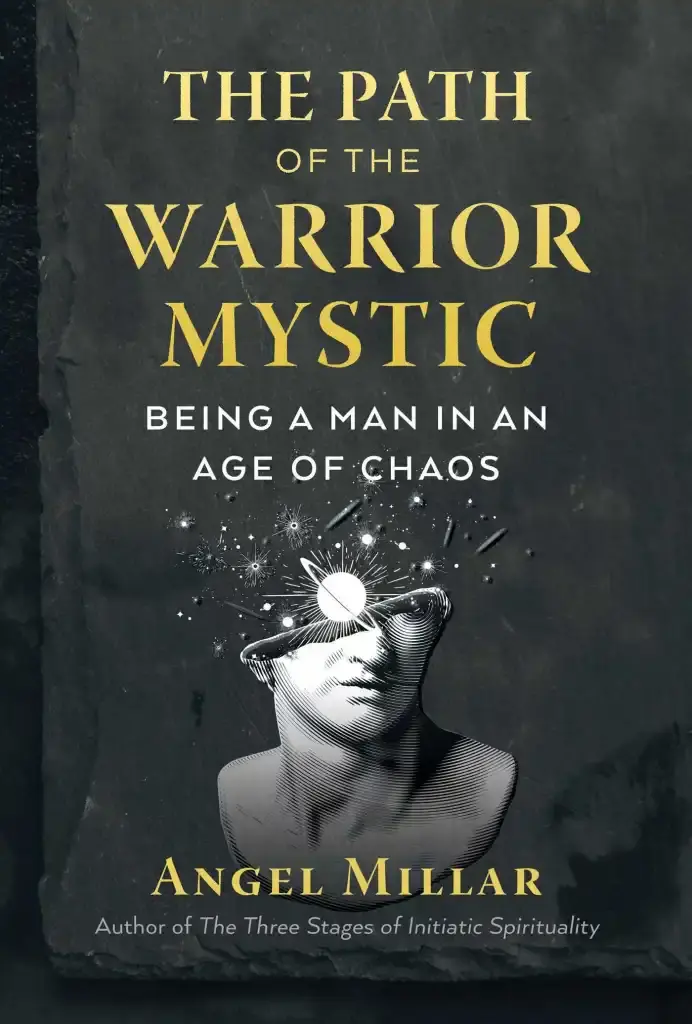
They are usually very one-dimensional. The pro-masculinity advocates put men in a box, usually reflective of some past era—the 1950s’ man with his wife, car, and financial security, or, perhaps, the 1980s’ man, partying and making money. These were already degenerate images of masculinity. They are, in different ways, about consumption. There is nothing heroic or spiritual about them.
Masculinity is dimensional. It’s more about drawing the different aspects of oneself into
something harmonious and—eventually—using that to go beyond our forerunners. Whether it’s being the first man to step foot on the North Pole or the moon or articulating a new philosophy that overturns those that were previously formulated, men—at least men of Will, or men who are admired by other men—always go further into the beyond.
If you’re going to go into the beyond, where no one has gone, you have to be sure of yourself—and that means embodying almost contrary forces. Hence, Plato was both a philosopher and a wrestler. The feared and notorious Viking warrior Egil Skallagrimsson was a renowned poet (and sorcerer). More recent are the soldiers and poets of World War I: Rupert Brooke, Siegfried Sassoon, and Wilfred Owen, among them. Again, Winston Churchill—Britain’s Prime Minister during World War II—was a historian and an amateur painter (as well as a Freemason and a one-time member of the Ancient Order of Druids). More formalized in Japan, there’s the classical notion of bunbu ryodo, the harmony of the physical arts (especially martial arts) with the arts of civilization (especially literature). If we look at the most political leaders today, they are usually little more than the position they occupy. They are one- dimensional.
It should be noted that masculinity is sometimes defined by sexual and financial success. But the former makes masculinity dependent on the approval of women, rather than the approval of men.
In regard to the latter, plenty of “yes men” have been raised to lucrative positions, and plenty of narcissists have exploited people financially.
Masculinity’s also been defined as the capacity for violence. But if there is no legitimate reason to be violent (i.e., to defend oneself, one’s country, or another person from physical attack), then,
logically, one cannot express masculinity legitimately. Moreover, a mother violently defending her children—or herself—from a predator is normal and natural. Indeed, women should know some self-defense. Having that capacity for violence doesn’t make them more masculine or less
feminine.
Being attractive, making an honest living, and a capacity for physical defense are all good in themselves. But, as I have implied, I do not think they are defining factors. In keeping with my thesis about going into the beyond, masculinity would seem to be intimately linked with self-control. Obviously, women can, and do, exhibit self-control. But if a woman cries because she’s had a hard day, no one thinks that that makes her less of a woman. If a man cries because he’s
had a hard day, if we’re honest, people will judge him as less of a man or as less masculine.
Men endure. Men who went to the North Pole experienced snow blindness, frostbite, and the loss of toes, among other physical torments. Yet, they kept going. The Impressionist painters were effectively banned from all official salons, which marginalized their work, and, of course,
severely limited their income. They kept going. Academics who articulate inconvenient truths are often fired from their university positions. Thinkers who articulate new ideas are attacked by
established interests. For teaching his philosophy, Socrates was ordered to commit suicide by drinking hemlock. He did so without complaint.
Today, people think they are rebelling when they give those opinions that the media and colleges inculcate, that corporations endorse, and that carry no risk of any kind of punishment. Notably,
such people often present themselves as being emotionally overwhelmed. I think this is illuminating.
To go beyond convention, self-control is essential. It is, after all, to risk everything.
But self-control doesn’t require extraordinary circumstances. It is something we can practice every day, whether it is focusing on our work, or controlling our temper if someone tries to rile us up. Hence, Roman emperor and Stoic philosopher Marcus Aurelius would begin each day by acknowledging that he would meet with the “busy-body, the ungrateful, arrogant, deceitful,
envious, unsocial.” In doing this, he could more easily remain undisturbed by them when he inevitably did encounter them. We all encounter such people.

Related to esotericism and masculinity, you talked about the archetypes of the Craftsman, Warrior, and Magician in The Three Stages of Initiatic Spirituality. Why these three?

There are different “archetypal” schemas, of course. We often hear about twelve archetypes.
These are used in marketing, and include such supposed “archetypes” as “the innocent” or “the everyman.” The number twelve makes it seem very ancient, but this schema was first proposed in a marketing book in 2001.
In regard to supposed male archetypes, some people might think of Douglas Gillette and Robert Moore’s King, Warrior, Magician, Lover: Rediscovering the Archetypes of the Mature Masculine, published in 1990. The problem with their schema is that it is fundamentally unbalanced and missing something obviously integral. If we take it seriously, the whole of male society must revolve around, or must have been built for, “the lover.” And, of course, there’s no “archetype” for growing food or making tools or weapons. It is the schema of a man who us unblanced and overly romantic.
The French philologist Georges Dumézil (1898–1986) claimed that the foundational castes of ancient Indo-European societies were the craftsman (or producer), warrior, and magician (or priest). I suspect that this is true for other ancient societies as well.
More recently (than Dumézil), historian David W. Anthony suggested that the herder/cultivator, warrior, and priest might have constituted “three age grades,” through which a man would naturally pass, if he lived long enough. An individual male would begin life as a herder or producer of some sort, would become a warrior when he reached maturity, and, later, when he
passed his physical peak, he would become a priest, a consul, or some kind of leader among his people.
In The Three Stages of Initiatic Spirituality: Craftsman, Warrior, Magician, I explore how these primal vocations shaped, and still shape, male spirituality. In regard to the craftsman, most notably, Freemasonry (sometimes called “the Craft”) not only emerged from stonemasonry, it uses the visual language of geometry and architecture symbolically and ritualistically. I also
explore other connections of craft, or creation, and the Divine, from Plato’s Demiurge (“Craftman” or “Artisan”) to Kabbalah.
In the warrior section of the book, I explore spirituality and both the physical body and mortality.
I look at such martial arts as Chinese Kung Fu (which I practiced for a long time) and the little-known Indian Kalaripayattu, among other traditions, physical, spiritual, and mystical.
Then, in the magician section, I explore occultism, sexual magic, and, briefly, even more modern traditions, such as Jungianism, Chaos Magic, and New Thought. The Three Stages of Initiatic Spirituality is about the whole man. It is holistic. It’s about reconnecting to these primal ways of being that our ancestors embodied. And it’s ultimately about re-embodying them in the world, and acting authentically.
You mentioned Jungianism. In Transcend the Chaos, you move more explicitly into psychology, self-development, emotional control, creativity, and navigating periods of uncertainty. How does this book develop ideas that were already present in your earlier work on initiation and personal transformation?

This book is for people who want to use primal—perhaps, even magical—powers in the world.
It’s for people who want to be effective and take control of their lives in this time of uncertainty and “disruption.” If The Three Stages of Initiatic Spirituality is the theory, and Path of the Warrior-Mystic is the philosophy, Transcend the Chaos is the practical application of the former
two books.
In Transcend the Chaos, I go into the forces that really govern our societies—and our world. I look at the qualities of the effective hypnotist (which are, not coincidentally, the same qualities as the effective leader and the effective person in his or her own life). I explore daily practices. I explore persuasion—so that the reader can become more effective in communication and so that they will be aware of the tricks that are being used on them every day. Lastly, I explore out-of-the-box thinking in a time of AI, and how to survive its disruption with what I call “the Six C’s”: connection, creativity, craft, culture, character, and consciousness.
This brings us to the subject of the genius, which you explore in Supernatural Woman and the Male Initiate: Bonded Through Dreams. But, unlike Path of the Warrior-Mystic, which is, in essence, about initiation in masculine traditions, here, the female appears as an initiator. More specifically, this book is about initiation by a supernatural woman. What led you towards this subject, and how did researching and writing the book change your understanding of initiation?

I’ve been initiated into various groups, Orders, and traditions, and all of these initiations were
conducted by men. Men initiating men is very ancient, of course. Men need guides. During my involvement with the group of neopagans at seventeen and eighteen, I had seen that goddess worship and the exaltation of women, verbally, could be used as a cover for chasing after women, sexually, in a rather pathetic way. So, afterwards, I tended to avoid such groups and
goddess symbolism and imagery.
Then, a few years ago, I was working on a series of essays, and the figure of the initiating woman—or female being—kept coming up in my research. Eventually, I realized that I needed to focus my time and energy on this subject, partly for a personal reason: I had been having dreams of a beautiful, raven-haired woman. And I had been entering a trance state and allowing the voice of inspiration to speak through me. The words came extremely fast. I would scribble them down. Soon, the texts suggested that the voice was that of a Hindu goddess. The dreams and the trance-induced transmissions seemed to be having an effect on my life, changing things in ways I couldn’t have predicted.
Looking back at your journey from neopganism and Chaos Magic to Freemasonry, and being an artist, designer, author, editor, and—occasionally—lecturer, what is the central question you feel you have been trying to answer throughout your work?
How can we live in accord with our destinies? To discover our destiny, of course, we have to begin to discern the spiritual that penetrates the mundane and holds it together—the web of Wyrd, as it might be called; the threads woven by the Fates, Moirai, or Norns. And it means
uncovering who we are, and sensing who we should be—mentally, physically, creatively, spiritually, and in terms of our character. Developing the character is essential. It’s what all civilizations tried to inculcate, but, today, the zeitgeist is very much one of wallowing in self-pity
and self-indulgence. For people who allow this of themselves, destiny is an alien concept. At best, they have been ensnared by fate.
You also have a background in fashion. What originally drew you to fashion, and how did your training and experience in that world shape your sense of aesthetics and creative expression?
I always thought of myself as very anti-fashion. I was very into Goth when I was in my teens. To me, “fashion” meant wearing whatever everyone else wore because it was dictated by the media.
I hated that.
When I attended Chelsea College of Art and Design, I came across the Japanese designers: Issey Miyake, Koji Tatsuno, Rei Kawakubo, and Yohji Yamamoto, and they were doing really interesting things. Tatsuno was making clothes out of organic materials or in really strange shapes. And Miyake was influenced by Japanese and European fashion, and was drawing on Samurai armour and origami for his garment construction. I found this very inspiring. I hadn’t seen anything like it. It opened my mind to what fashion could be, and how it could embody ancient tradition, nature, and the spiritual.
In regard to my own creative expression, I was especially inspire by Tatsuno. At Saint Martins College of Art Design, later on, I created a quilted Chinese-style jacket, which I coated with a type of oil to make it sheer, and sewed leaves into it. Eventually, the fabric darkened, and the leaves broke apart. It was interesting to see.
Fashion also helped me to understand that appearances matter—and that they should matter.
People think that clothing is superficial, but it is a language just as much as verbal language. And it matters what we say. Well into the 1960s, women made clothes for their children and for themselves. They weren’t mere consumers. In the history of Freemasonry, too, women made
Masonic regalia. These were often the wives and daughters of Freemasons, but there were also regalia shops run by women. It is part of the history of Freemasonry and part of the history of the USA, though it is little-known.
We don’t understand the history of clothing or what clothing means—why it’s cut the way it is, and for what function. We talked about masculinity. Men don’t understand the suit. A lot of men
even hate it because—to them—a suit suggests the sort of success or power that eludes them. But this type of thinking is a symptom, not only of our detachment from masculinity, but of our detachment from the physical body and the physical world.
You embody a very well-rounded approach to life: art, magic, and freedom all seem to
matter to you. Do you see these as separate interests, or as different expressions of the same philosophy of how a man should live?
We live in a fragmented society partly because we have become specialized. A person does one thing, professionally. And, often, this becomes a person’s whole identity. Most especially, people tend to see themselves as a type: intellectual, spiritual, or physical. They want to fit in to some group. But human beings are complex and multidimensional.
Ultimately, we have to cultivate, enlarge, and integrate the different aspects of ourselves. You see this with warriors in classical civilizations: They practiced the arts of war and peace. In Japan, this is bunbu ryodo. From bun, “literature,” “study,” etc.; bu, “martial arts”; and ryodo, meaning “together,” this is the integration of the art of war and the arts of civilization or
literature. Even during World War I, war poets were famous in the West. These were soldiers who fought and wrote poetry about the war they experienced and the carnage they witnessed.
Yet, there was no self-pity in their words. Rather, they were infused with a Stoic and heroic spirit that enabled them to go on.
So, no, I don’t see these different aspects of myself, or my different interests, as separate. I see them as overlapping or as integrated with each other. As I have noted in my books, geniuses, creative pioneers, and those who invent new things or make new discoveries are often accomplished in more than one field, or are able to draw from multiple fields. Hence, Charles Darwin was inspired, in his theorizing of natural selection, by the economist Thomas Malthus.
Samuel Morse (known for inventing Morse Code) was a portrait painter and a scientist who experimented with electricity. Probably Japan’s best-known fashion designer, Yohji Yamamoto, studied law at university. Such pioneers are not specialists. They are more like living networks.
We have both a romantic relationship and a creative and professional partnership. What do you think is essential for keeping those different dimensions balanced, while allowing both the relationship and the work to flourish?
A few things: Firstly, the desire to really know each other (which implies respect for each other).
Secondly, a desire to keep growing, individually as well as together. Thirdly (and relatedly), wanting the best for each other and pushing each other toward excellence. And, fourthly, a sense that we are facing the chaos of the world together, and discovering the beauty in it.

Comments