The Birth of Lua Valentia
- Lua Astor
- 24 hours ago
- 4 min read

When I was a teen, a friend of mine, Willian Lucas, introduced me to Chaos Magic. He lent me several books, and I began where many chaos magicians eventually begin: with Austin Osman Spare. From there, I moved into Peter J. Carroll's Liber Null & Psychonaut, practising Liber MMM and gradually learning that magic was a technology of transformation.
At that age, I did not yet possess the language to describe what was happening. I only knew that something had opened. Spare gave me the first glimpse of the unconscious as a field of power. Carroll gave me method. Chaos Magic gave me permission to experiment.
Years later, I met an occultist who introduced me to Thelema and to technomagic, particularly his work with technology, algorithms, and the occult potential of digital systems.
Through him, I encountered the possibility that magick could move through code, networks, machines, images, platforms, and invisible architectures of influence.
It was during this period that I began to write Lua Valentia into existence.
In a black notebook, I wrote line by line who she was meant to be.
Lua: the one initiated into the dark feminine current. The one who does not apologise for her hunger, her intuition, her depth, or the force of her perception.
Valentia: the courageous one.
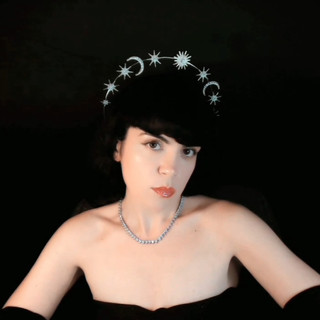
She was everything I had not yet permitted myself to become. She was not shy, not small, not obedient, not harmless. She was magnetic, sovereign, and unsettling in the way some women become unsettling when they cease asking for permission to exist.
I wrote her as though I were writing a contract.
Then I understood that if I wished to create her, I would also need to recreate my origin. I had been born on a rainy Friday, a day already marked by Venus, beauty, fate, and strange melancholy.
When I performed the ritual birth of Lua Valentia, it was also a Friday. It was raining heavily. The sky was dark and violent, split by lightning, filled with thunder that seemed to tear through the atmosphere with teeth.
It felt as though the heavens had recognised the seriousness of the act. The weather itself became participatory, almost conspiratorial.
As little girls create vision boards of flowers, princes, future houses, and innocent dreams, I created a vision board for her. Mine was an iconostasis, an altar of becoming.
I gathered images of women who looked untouchable, women whose faces carried command in the mouth and silence in the eyes. Black lace, velvet, libraries, gothic architecture, perfume bottles, daggers, crowns, Greek statues, roses, moonlit streets, pomegranates, dark corridors, old mirrors, and the visual grammar of power.
Lua Valentia was an operation, an identity sculpted through discipline, obsession, ritual, and repetition. She was an idea fed until it demanded flesh. She became my hypersigil: an extended spell distributed across months and years, disguised as daily life. Every photograph, every garment, every ritual, every word, every silence, every refusal, and every act of courage fed her into manifestation.
Lua Valentia was forged through blood, sweat, and tears. She grew inside me like a seed planted in ruin, slowly consuming the soil of the old self. My birth name became a ghost name. I began to forget how it felt to inhabit her softness, her hesitation, her fear of being seen. I stopped hearing her name inside my mind.
I began to hear only Lua.
At first, Lua was not entirely real. She was myth. She was a figure glimpsed in dreams and nightmares, an apparition returning night after night, patient and severe, waiting for surrender.
Day after day, I surrendered.
Day after day, I became more of her.
The transformation did not occur through one grand dramatic gesture. It emerged through small, precise acts. The way I walked. The way I spoke. The way I held my posture as though the spine itself were a vow. The way I stopped explaining myself. The way I stopped apologising for the intensity of my perception. The way I learned to occupy space without asking whether I was allowed to be there.
The occultist I met taught me a great deal about magickal narrative. He understood that identity could be engineered, that persona could function as a vessel of power, and that the self could be rewritten through symbol, technology, and repetition. Yet our beliefs were not the same.
He believed occultism should remain hidden from the masses. He believed I should not teach openly or post about these matters on social media. He was entirely opposed to the public dissemination of occult knowledge through digital platforms.
I disagreed.
For me, the internet was not an obstacle to the Work. It was part of the Work. Social media was a field of transmission. Images, words, posts, videos, names, symbols, and repeated motifs could operate as hypersigils moving through collective perception. The digital world was already astral in structure: invisible, symbolic, emotional, memetic, and governed by attention.
Despite our differences, he agreed to help me create Specula.
Specula began as an homage to Peter J. Carroll, but it was never intended to remain a simple tribute. I wanted it to become an entire magickal system of tools, servants, thought forms, currents, paths, practices, and astral territories. I wanted a world.
Specula was born from Chaos Magic, technomagic, personal gnosis, and the deliberate construction of identity. It carried the inheritance of Spare, Carroll, Thelema, digital experimentation, and my own becoming. It emerged from the recognition that the magician need not merely choose among existing systems, they may build one.
This was the beginning of Specula’s System. And, in a deeper sense, it was the beginning of Lua Valentia as a living current.


Comments